AI for CMOs
How CMOs Can Review AI-Assisted Campaign Content for Audience Value
SimplSolutions Editorial Team · 7 min read
Published
The real problem is not whether AI wrote the draft
A campaign team can produce a landing page, email, or ad variation in minutes and still leave the reader with the same generic claims found everywhere else.
That creates a more useful CMO question than “Was AI used?”:
What does this asset help the audience understand or do that a generic version would not?
AI assistance is not, by itself, evidence of quality. Before publication, a campaign team needs to be able to explain the audience need, the approved information behind the asset, the human judgment applied to it, and its specific contribution to the reader.
This is a governance question as much as an editorial one. It helps teams avoid treating fluent copy as finished work simply because it arrived quickly.
A pre-publication test for audience value
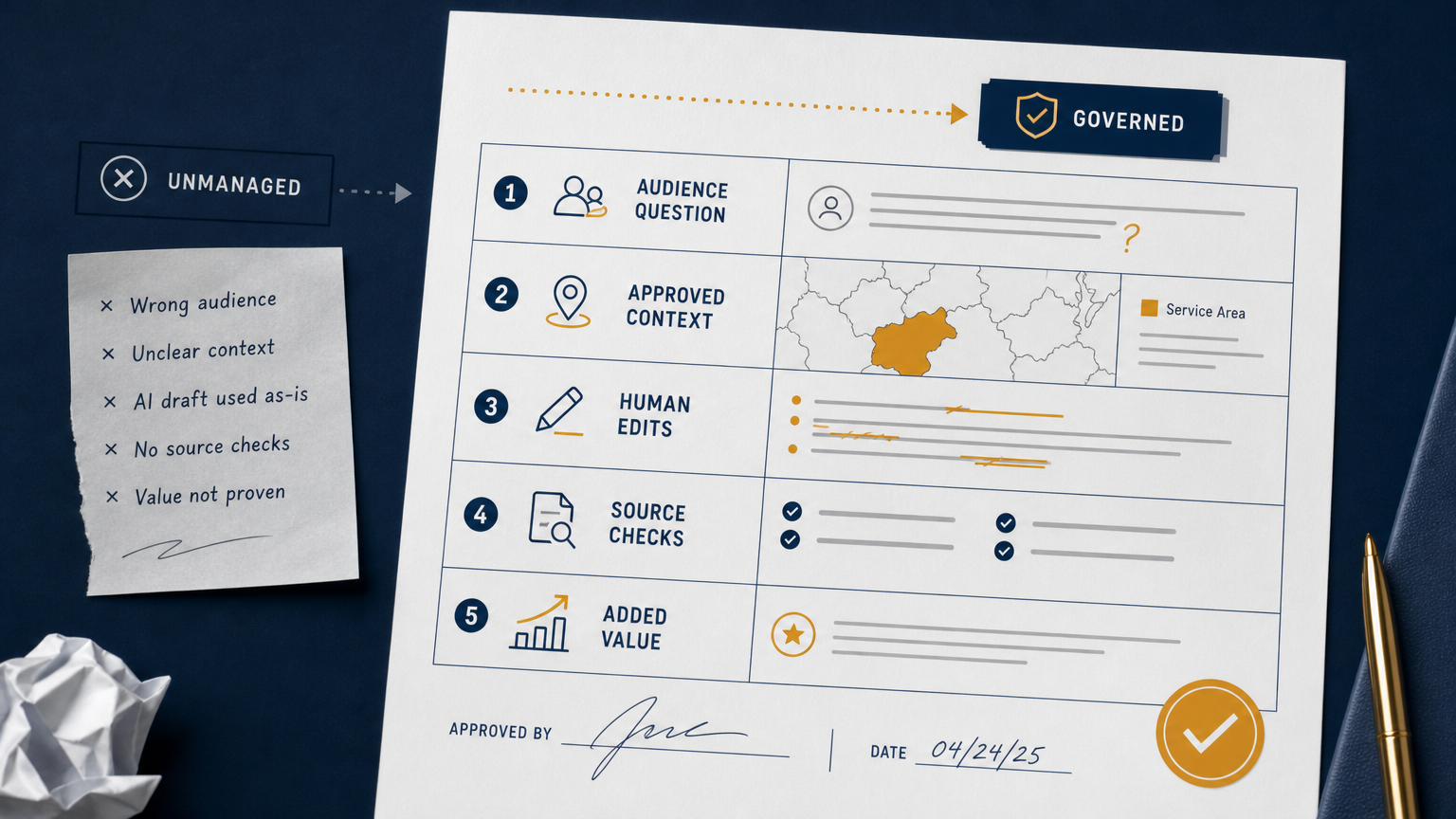
Before an AI-assisted asset enters final approval, ask the team to complete five evidence fields.
1. What audience need does this asset address?
Write the question in the audience’s language, not as a keyword target or internal production objective.
Weak: “Create a location landing page for the regional campaign.”
Stronger: “What should a customer in this service area know before deciding whether this offer is relevant to them?”
The answer should identify an audience, situation, decision, or uncertainty. If the team cannot state the need clearly, the asset may be serving a publishing schedule rather than a reader.
A useful question is specific enough to shape the page. It should help the team decide what belongs in the asset, what can be left out, and what information would make the next step clearer for the customer.
2. Which facts and brand context are approved?
List the business information the asset is permitted to use. Depending on the campaign, that may include approved service descriptions, operating areas, eligibility conditions, product limitations, support details, offer terms, or required legal language.
Do not treat generated output as a source. A reviewer should be able to trace material claims to approved information or remove them from the asset.
This check extends beyond body copy. Titles, descriptions, structured data, image text, and alternative text can carry claims or create misleading impressions. The same discipline should apply wherever a campaign asset represents the business to an audience.
For higher-risk content, teams may adapt the depth of review to the context. A regulated statement, location-specific promise, pricing reference, or offer condition may warrant more detailed evidence than a low-risk formatting variation.
3. What did a person add, decide, or reject?
“Human reviewed” is too vague to be useful. Record the meaningful editorial contribution instead.
Examples may include:
- a subject-matter decision about what the audience needs first;
- a product-specific or location-specific fact selected from approved information;
- a claim removed because it was unsupported or too broad;
- a qualification added to reduce the risk of a misleading interpretation;
- a revised explanation that makes a customer decision easier.
This does not mean every sentence must be written from scratch. It means the team can show where informed judgment changed the asset’s usefulness, clarity, or trustworthiness.
The record is especially valuable when several people contribute to an asset. It makes clear which decisions were editorial choices, which were sourced facts, and which require ownership at final approval.
Make source checks and value visible
4. What sources were checked?
Create a short source record for material claims. It can identify the approved business source, the version or date reviewed where relevant, and the person responsible for checking it.
The review should distinguish three things:
- Source evidence: what approved business information or another credible source supports.
- Editorial interpretation: how the campaign uses that information for its audience.
- Campaign language: the final wording and any qualification added by the team.
That separation makes later review faster. It also reduces the risk that a confident sentence is mistaken for verified information.
The goal is not to create a lengthy research file for every asset. It is to make the basis for material claims visible enough for the appropriate owner to assess them.
5. What specific value does this asset add?
The answer should be concrete. “It is optimized” or “it is more engaging” is not enough.
An asset may add value by clarifying a complex choice, answering a location-specific question, explaining a limitation, organizing approved information around a customer decision, or combining verified details in a form the audience can use.
The test is not whether the copy sounds different. It is whether the reader receives relevant help that a generic version would not provide.
Worked example: from generic landing page to regional usefulness
Consider an illustrative regional campaign team preparing a landing page for customers in a particular service area. The first AI-assisted draft uses broad language: it promises convenient service, highlights general customer benefits, and repeats a call to action. The draft is not necessarily inaccurate, but it could describe almost any region.
Before approval, the team documents the customer question:
What is available to people in this area, and what should they confirm before contacting the business?
The team then limits the revision to approved information about that region. The page names the relevant service area only where coverage has been confirmed, explains a real qualification or limitation where applicable, and directs the reader toward the next decision rather than adding unsupported local detail.
A reviewer removes a broad convenience claim that is not supported by the approved material. Another checks the location language, title, description, and image alternative text for consistency with the approved context.
The final page remains AI-assisted, but its audience value is easier to explain: it organizes verified regional information around a question that a generic landing page did not answer.
This example does not predict a ranking, conversion, or engagement result. It demonstrates a stronger approval record. The team can show the original audience need, the permitted context, the decisions made by people, and the claims reviewed before publishing.
What a CMO should see in the approval record
A useful record does not need to become a bureaucratic essay. A compact review entry can include:
| Review field | Evidence to capture |
|---|---|
| Audience need | The customer question or decision the asset addresses |
| Asset purpose | Why this page, message, or variation is needed |
| Approved context | The business information permitted for use |
| Human contribution | Decisions, additions, removals, and qualifications |
| Source checks | References supporting material claims |
| Audience value | What the audience gains beyond a generic version |
| Risk disposition | Claims, locations, offers, or wording requiring escalation |
| Final owner | The person accountable for approval |
The record should be proportionate to the risk and operating context. Teams may need to apply additional review for subjects involving legal, regulatory, privacy, accessibility, pricing, or offer requirements. The central question remains the same: why should this asset exist for this audience?
What this review can and cannot do
A documented review improves the basis for an editorial decision. It helps a team see whether an asset relies on unsupported claims, generic language, or unexplained assumptions. It also gives owners a clearer record of what was approved and why.
It does not create a universal originality score. It does not guarantee that an asset will rank, earn engagement, convert, or perform better than another version.
Performance evidence comes later and should be interpreted carefully. An underperforming asset does not prove that AI assistance was the cause. A successful asset does not show that automation alone produced the result. The pre-publication record is valuable because it makes the decision inspectable before outcome data is available.
A practical next step for campaign teams
Add an audience-value checkpoint to the existing campaign approval process. Require the owner to answer five questions:
- What audience question are we answering?
- Which facts and brand context are approved?
- What did a human reviewer add, change, or reject?
- Which material claims and metadata were checked against sources?
- What does this asset provide that a generic version would not?
If the answers are thin, the team can revise the asset, narrow its claim, combine it with a more useful customer question, or decide not to publish it.
The point is not to turn every campaign into a lengthy documentation exercise. It is to ensure that faster content production does not displace the judgment required to make campaign content genuinely useful.